Nitrogen: Difference between revisions
Jump to navigation
Jump to search
added image and == Abundances in space == |
mNo edit summary |
||
| (4 intermediate revisions by the same user not shown) | |||
| Line 7: | Line 7: | ||
* '''BN boron nitride''' [https://en.wikipedia.org/wiki/Boron_nitride] | * '''BN boron nitride''' [https://en.wikipedia.org/wiki/Boron_nitride] | ||
* '''AlN aluminium nitride''' [https://en.wikipedia.org/wiki/Aluminium_nitride] (note: the phosporus analogon is highly toxic) | * '''AlN aluminium nitride''' [https://en.wikipedia.org/wiki/Aluminium_nitride] (note: the phosporus analogon AlP is highly toxic) | ||
* GaN gallium nitride [https://en.wikipedia.org/wiki/Gallium_nitride] (gallium is rare) | * GaN gallium nitride [https://en.wikipedia.org/wiki/Gallium_nitride] (gallium is rare) | ||
* InN indium nitride [https://en.wikipedia.org/wiki/Indium_nitride] (indium is very rare) | * InN indium nitride [https://en.wikipedia.org/wiki/Indium_nitride] (indium is very rare) | ||
| Line 14: | Line 14: | ||
---- | ---- | ||
'''Carbon Group:''' | '''Carbon Group:''' | ||
* '''β-C<sub>3</sub>N<sub>4</sub> beta carbon nitride''' [https://en.wikipedia.org/wiki/Beta_carbon_nitride] | * '''β-C<sub>3</sub>N<sub>4</sub> beta carbon nitride''' [https://en.wikipedia.org/wiki/Beta_carbon_nitride] – [[Beta carbon nitride]] | ||
* '''Si<sub>3</sub>N<sub>4</sub> silicon nitride''' [https://en.wikipedia.org/wiki/Silicon_nitride]<br> [[pseudo phase diagram]] towards SiO<sub>2</sub> is filled by silicon_oxynitride [https://en.wikipedia.org/wiki/Silicon_oxynitride] -- mineral: Si<sub>2</sub>N<sub>2</sub>O sinoite [https://en.wikipedia.org/wiki/Sinoite] | * '''Si<sub>3</sub>N<sub>4</sub> silicon nitride''' [https://en.wikipedia.org/wiki/Silicon_nitride]<br> [[pseudo phase diagram]] towards SiO<sub>2</sub> is filled by silicon_oxynitride [https://en.wikipedia.org/wiki/Silicon_oxynitride] -- mineral: Si<sub>2</sub>N<sub>2</sub>O sinoite [https://en.wikipedia.org/wiki/Sinoite] | ||
* Ge<sub>3</sub>N<sub>4</sub> [https://en.wikipedia.org/wiki/Germanium_nitride] (Ge is rare) | * Ge<sub>3</sub>N<sub>4</sub> [https://en.wikipedia.org/wiki/Germanium_nitride] (Ge is rare) | ||
| Line 83: | Line 83: | ||
* [[Chemical element]] | * [[Chemical element]] | ||
[[Category:Chemical element]] | [[Category:Chemical element]] | ||
* [[Oxygen]] | |||
* [[Simple metal containing carbides and nitrides]] | |||
---- | |||
* [[Nierite]] = Si<sub>3</sub>N<sub>4</sub> silicon nitride | |||
== External links == | == External links == | ||
Latest revision as of 15:19, 2 November 2025

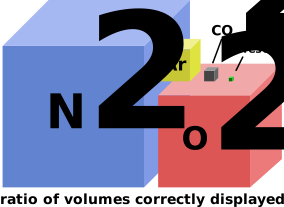
(variable atmospheric humidity omitted)
Nitrides
Very valuable gemstone like compounds.
- BN boron nitride [1]
- AlN aluminium nitride [2] (note: the phosporus analogon AlP is highly toxic)
- GaN gallium nitride [3] (gallium is rare)
- InN indium nitride [4] (indium is very rare)
- BCN Heterodiamond [5]
Carbon Group:
- β-C3N4 beta carbon nitride [6] – Beta carbon nitride
- Si3N4 silicon nitride [7]
pseudo phase diagram towards SiO2 is filled by silicon_oxynitride [8] -- mineral: Si2N2O sinoite [9] - Ge3N4 [10] (Ge is rare)
- Sn3N4
- no lead nitrides?
Nonmetallic: (mid level abundance elements)
- Cu3N copper(I)-nitride (de: [11]) despite the metal excess nonmetallic -- (and Ag3N silver nitride [12])
- Zn3N2 zinc nitride [13]
- Na3N [14] (reacts with water, exotic structure) and Li3N lithium nitride [15] (lithium is not too abundant)
- Mg3N2 magnesium nitride [16] (reacts with water) and Be3N2 beryllium nitride [17] (Be is rare and poisonous)
- Ca3N2 calcium nitride [18] (reacts with water)
- potassium nitride?
Metallic:
- TiN titanium nitride [19] and ZrN zirconium nitride [20] and YN yttrium nitride [21]
- VN vanadium nitride [22] and NbN niobium nitride [23] and TaN tantalum nitride [24] (vanadium, niobium and tantal range from rare to very rare)
- CrN chromium nitride [25] (chromium is not too abundant) and WN tungsten nitride [26] (tungsten is rare - compound susceptible to water)
- Fe2N (Fe3N) Fe4N Fe7N3 Fe16N2 -- diverse iron nitrides [27]
Molecular solids (not really suitable as structural materials):
- Volatile molecular solid: S2N2 [28]
- molecular solid: α,γ,δ P3N5 [29]
- Tellurium_nitride? [30] (Te is very rare)
Wikipedia: Nitride Category:Nitrides
Explosive
Since nitrogen likes to form strong triple bonds with low energy (N2 gas) many nitrogen compounds are explosive.
Nitrates
The salts of the nitrogen acids are usually rather water soluble.
Even the earth alkali salts.
Since they are also rather soft even isolated against environment they seem unsuitable as structural materials.
- NaNO3 sodium nitrate [31] (common name: soda) mineral: nitratine [32] Mohs 1.5-2
- KNO3 potassium nitrate [33] (common name: salpeter) mineral: niter [34] Mohs 2
- Mg(NO3)2 magnesium nitrate [35] (as hexahydrate: nitromagnesite)
- Ca(NO3)2 (as tehrahydrate: nitrocalcite)
Sodium is the cationic counterpart that makes salts maximally water soluble.
Related: Salts of oxoacids
Misc
- Nitrogen can (in form of the ammonium ion) take the place of a electro-positive metal in a salt. This is very unusual for a nonmetal. (Wikipedia: Ammonium_salts)
- By dissolving sodium in ammonia one can solvate free electrons. (Wikipedia: Solvated_electron)
Abundances in space
- On Venus there is a dinirogen partial pressure of 3.22bar at fround level (3.5% of 92 bar)
- On Mars of the already thin atmosphere (~6mbar), nitrogen makes only a small fraction. It's much more than nothing though.
- Titan has a thick nitrogen atmosphere (that is not much about liquification temperature)
- Pluto seems to have parts of his crust made out of a giant convecting glacier that is mostly frozen nitrogen
- The Ice moons might have harbor large amounts of ammonia (liquid or frozen) – might have a sterilizing effect
Related
- Nierite = Si3N4 silicon nitride
External links
- cubic gauche solid nitrogen (cg-N)
This is the explosive with highest known energy density. - Isotopes of nitrogen
– 99.6% 14N – unusual whole numbered spin
– 0.4% 15N – used for nitrogen-15 nuclear magnetic resonance spectroscopy (NMR) and nitrogen-15 tracing